Solving the Mobile App Dilemma for Growing Businesses
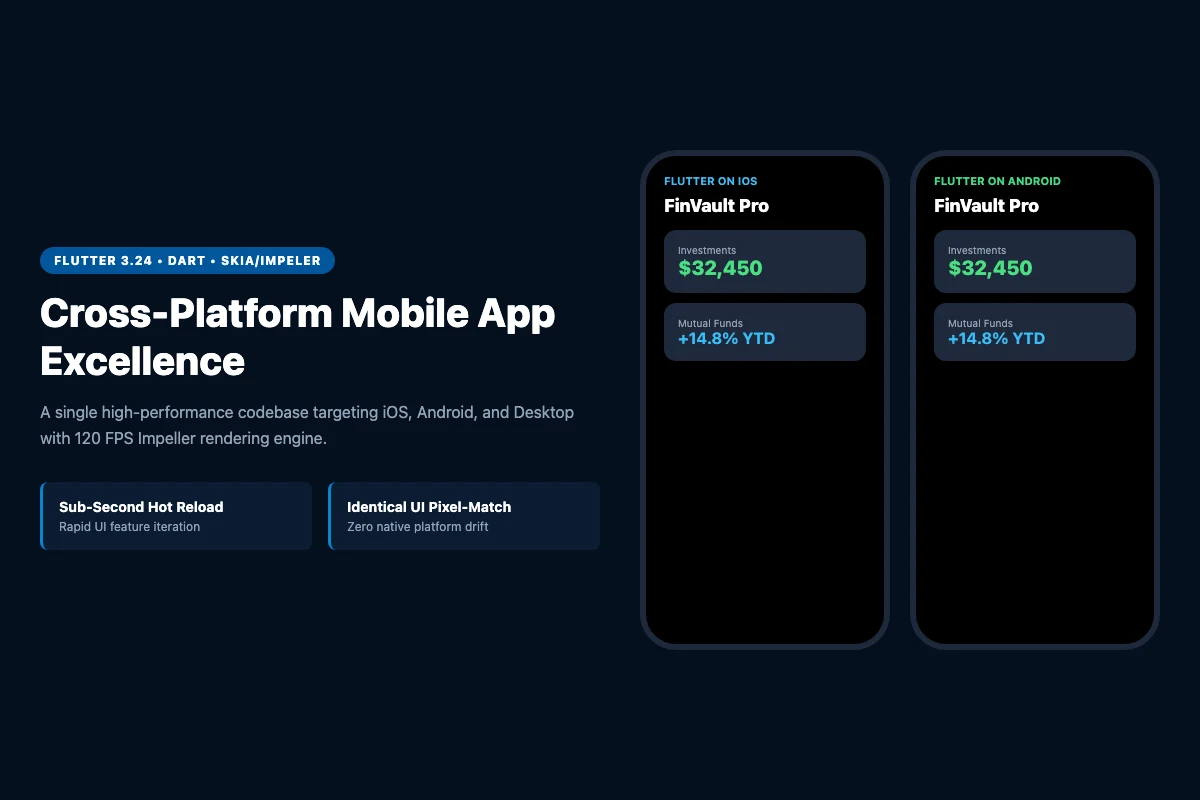
For startups and expanding enterprises in Coimbatore and Tamil Nadu, building a mobile app historically meant funding two separate engineering teams: one for Swift/iOS and another for Kotlin/Android. This doubled development costs, extended launch timelines, and created maintenance headaches. Google's Flutter framework has revolutionized mobile development by delivering authentic native performance from a single codebase.
1. Single Codebase, True Native Performance
Unlike older hybrid tools that ran web pages inside mobile web views, Flutter compiles directly to native ARM machine code. With its custom Impeller rendering engine, Flutter achieves silky 60fps and 120fps animations on both iOS and Android. Users cannot distinguish a well-built Flutter app from a native Swift or Kotlin application.
2. Up to 40% Cost and Timeline Reductions
Writing, testing, and maintaining one unified Dart codebase cuts initial development expenditure by 35% to 45%. Furthermore, feature updates, bug fixes, and third-party API integrations (such as Razorpay, Firebase, or Google Maps) only need to be written once, accelerating your time-to-market dramatically.
3. Flutter vs React Native
While React Native remains popular for teams with heavy JavaScript backgrounds, Flutter eliminates the JavaScript-to-Native bridge entirely:
- ✓ Predictable Rendering: Flutter controls every pixel on screen, ensuring identical UI across fragmented Android devices.
- ✓ Strong Typing: Dart provides compile-time type safety, catching bugs before apps reach customer hands.
- ✓ Google Long-Term Support: Backed by Google and used by global brands like BMW, eBay, and Google Pay.
4. Conclusion & Next Steps
If your company plans to launch a customer-facing retail app, an on-demand booking service, or an internal enterprise workforce app, Flutter provides the highest return on investment. Speak to Branzo Techno Solution in Coimbatore to discuss architecture and project scoping.

Founder and technical director at Branzo Techno Solution, Coimbatore. Directing custom web design, mobile app architecture, and enterprise software engineering across Tamil Nadu.