Choosing the Right Backend Architecture for Indian Enterprises
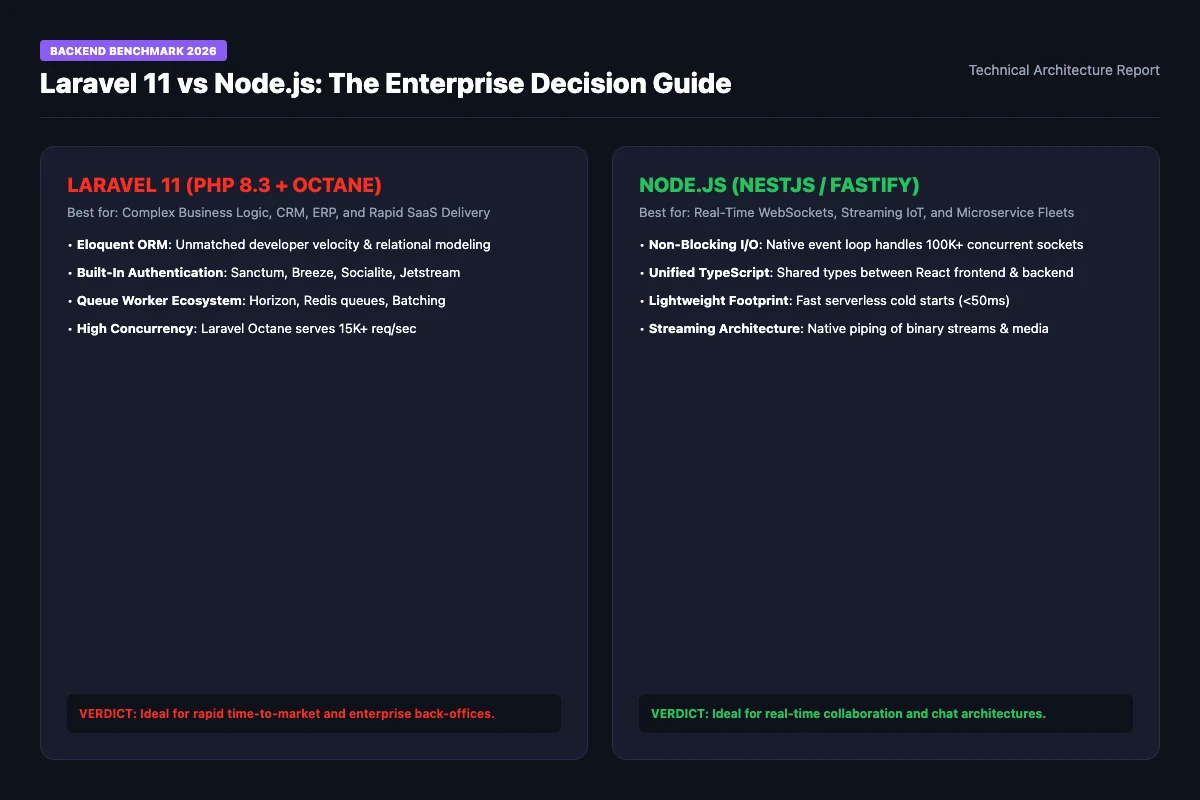
When building custom software, an internal ERP, or an e-commerce platform in Coimbatore, selecting the right backend technology is one of your most consequential architectural decisions. Laravel (PHP) and Node.js (JavaScript/TypeScript) represent two of the world's most dominant backend ecosystems. Each has distinct strengths depending on your concurrency needs, budget, and project roadmap.
1. Laravel: Rapid Development, Stability & Enterprise Structure
Laravel is a mature MVC (Model-View-Controller) framework designed for developer productivity. It provides built-in authentication, queue workers, database migrations, and Eloquent ORM out of the box. For business management applications, ERPs, CRM software, and administrative portals, Laravel allows engineering teams to ship production-ready features significantly faster than starting from scratch.
2. Node.js: Event-Driven Concurrency & Real-Time Performance
Built on Chrome's V8 JavaScript engine, Node.js uses an asynchronous, non-blocking I/O model. This makes it extraordinarily fast at handling thousands of simultaneous connections with low server memory consumption. If you are building a real-time tracking application, live chat platform, streaming service, or IoT telemetry dashboard, Node.js is the superior choice.
3. Regional Talent Availability & Long-Term Maintenance
In Coimbatore and Tamil Nadu's tech corridors, both Laravel and Node.js enjoy abundant developer talent. Key operational factors include:
- ✓ Hosting Infrastructure: Laravel deploys easily on standard Linux VPS or shared servers; Node.js requires process managers (PM2) or containerized environments (Docker).
- ✓ Security Defaults: Laravel comes pre-configured with CSRF protection, SQL injection prevention, and password hashing by default.
- ✓ Full-Stack Unification: Node.js enables full-stack JavaScript (React/Vue on frontend, Node on backend), allowing developers to share types and validation logic.
4. Conclusion & Strategic Recommendation
Neither technology is universally better—they serve different use cases. At Branzo Techno Solution, we build complex business management portals, e-commerce platforms, and CRM systems with Laravel for dependable stability, while leveraging Node.js for high-speed APIs, notification microservices, and real-time dashboards.

Founder and technical director at Branzo Techno Solution, Coimbatore. Directing custom web design, mobile app architecture, and enterprise software engineering across Tamil Nadu.